
Like other auto companies, Ferrari had been regularly releasing new models. It’s a brand that would always catch people’s attention, so there’s no reason for Ferrari to stop innovating or slow down their release schedule. However, the release of the SF90 Stradale as the first Ferrari plug-in hybrid sports car was news that garnered massive attention.
It made a mark in the company’s whole history as it’s their very first plug-in hybrid. The name brings in the SF90 branding coming from the Formula 1 racing team Scuderia Ferrari. Meanwhile, the 90 commemorates its 90th anniversary.
This groundbreaking Ferrari hybrid showcases a power like no other. With 986 horsepower, the car tops every model that Ferrari has ever released before.
Ferrari looked at the SF90 Stradale as a new benchmark for innovative content and performance. Not only for Ferrari, but hopefully for the whole industry. So, what can the SF90 Stradale offer to its potential proud owners as the first Ferrari plug-in hybrid?
What’s Under the Hood
Ferrari’s SF90 Stradale boasts a 3.9-litre V8 engine that can produce 769 horsepower on its own. The internal combustion engine comes with three electric motors, two working independently on the front axle, and the other one placed at the rear between the gearbox and the engine.
The eight-speed dual-clutch transmission is attached to the rear electric motor, contributing a combined 84 horsepower. So, theoretically, the three motors, while limited by the capabilities of the battery pack, can produce up to 217 horsepower. As a hybrid car, these three electric motors’ primary role is to add a power boost to the car’s entire performance without making it an electric cruiser.
Adding those to the V8’s power, the total horsepower that the Ferrari SF90 Stradale can provide is approximately 986 to 1,000 hp. This powerful combination had made the car Ferrari’s number one in terms of speed. The new plug-in hybrid can go from 0 to 60 mph (0-100 km/h) in mere 2.5 seconds. The maximum speed you can get from this powerful vehicle is 211 mph (340 km/h).
The car comes with electric power, so drivers can rely on electric power alone for up to 25 km (15 mi). The speed can get up to ~135 km/h (84 mph) during eDrive mode, powered solely by the 7.9-kilowatt-hour lithium-ion battery. You can also plug the electric motors into the standard power source with the V8 engine acting as the generator.
So far, Ferrari hasn’t announced how long it’ll take to fully charge the car. Potential buyers are also still not very clear about how much it’ll cost to insure this new PHEV.
In addition, not only is the SF90 Stradale the first Ferrari plug-in hybrid, it also marks the debut of Ferrari’s AWD sports car. The overall power output is distributed to all four wheels, with the two front tires running electrically.
So, which model is the first Ferrari PHEV hybrid car? It’s the SF90 Stradale. However, the SF90 Stradale isn’t the brand’s first hybrid car, but it’s a notable achievement because this is the first plug-in hybrid.
So, it’s not the same as their first Ferrari hybrid, the LaFerrari, which was introduced in 2013, nor the same as the LaFerrari Aperta convertible released in 2016. This new PHEV hybrid Ferrari might just help Italy win the debate over which country makes the best supercars.
Interior Design
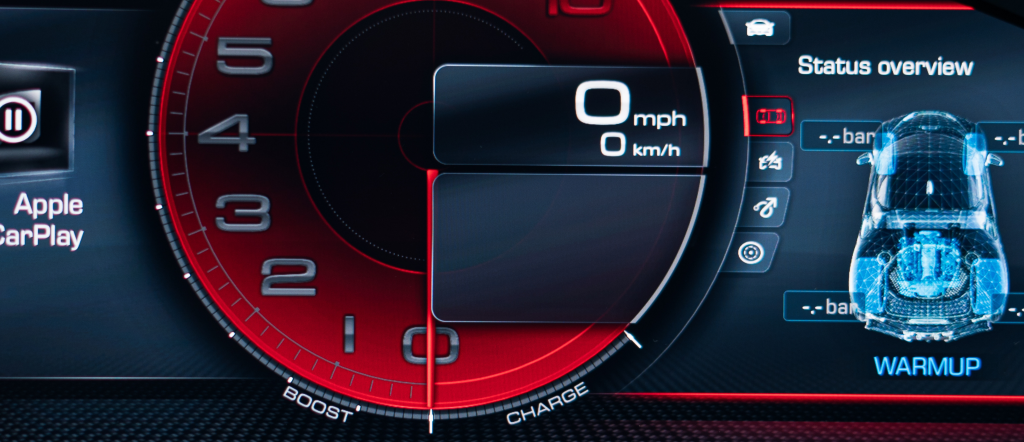
When it comes to interior design, the SF90 Stradale is just as impressive. The car came with a massive 16-inch curved display behind the steering wheel, replacing the conventional gauge cluster. Drivers can utilise this display for various infotainment functions.
You won’t find central touchscreens, but instead, the Stradale offers capacitive touchpads to control the display’s menus and head-up display. It also has touch-sensitive surfaces on the steering wheel for the engine’s start-stop switch, alongside other controls.
The dashboard also features touch-sensitive surfaces, but they’re within a good range for drivers to reach. You can use this area for mirror adjustments and climate control. Ferrari stated that these areas are designed to ensure that drivers can interact with things without removing their hands from the steering wheel too much.
The rest of the features aren’t far off from the usual design, including the windshield wipers and Ferrari headlight controls. Both are integrated into the steering wheel.
Exterior Design
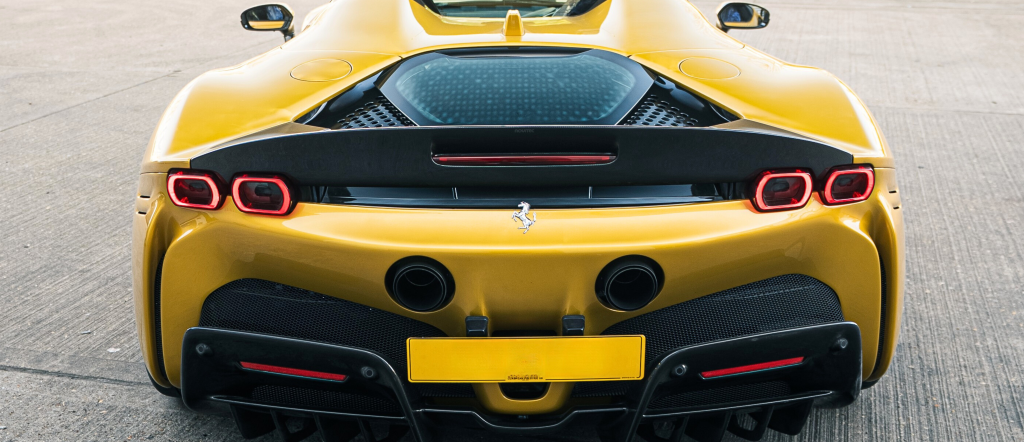
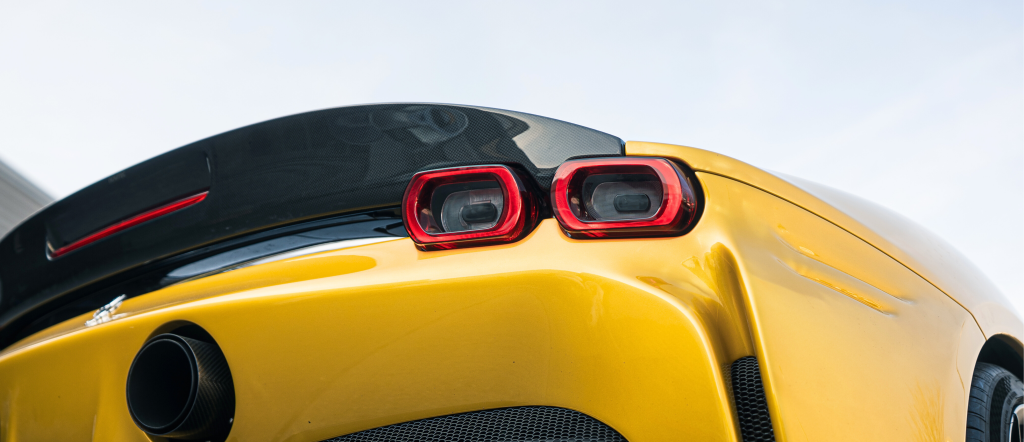
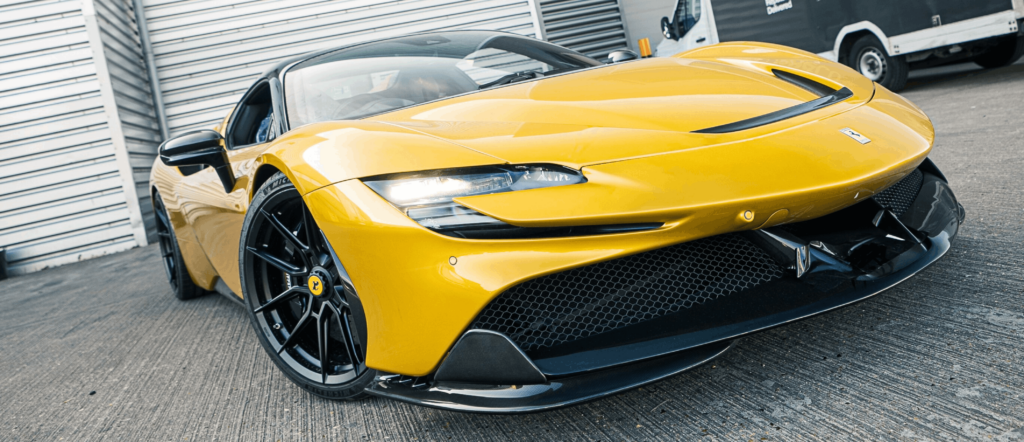
The exterior of the SF90 Stradale is nothing if it doesn’t reflect Ferrari’s iconic design. It shows a futuristic and modern exterior that’s aesthetically very Ferrari. There’s a matrix LED headlight technology installed for visibility. The Ferrari plug-in hybrid car’s body is a sleek coupe style with a bubble-shaped cabin and curved windshield.
The black roof merges well with the windows, giving an all-glass look at the top. You can see the rear-mounted engine through glass covers, and the exhaust exits from the rear. We have even taken the design up another notch with a number of Novitec builds on the SF90 Stradale and spider, check out one of our recent projects via our Instagram. Novitec SF90
Four Drive Modes
We’ve talked about the eDrive mode a bit, but it may not be the best option to use too often. You can only drive for around 25 km (15 mi) with a maximum of approximately 135 km/h (84 mph) tops, so that’s not the first way to go with the SF90 Stradale. Uniquely, the car would always switch on electric mode when backing up, as the transmission comes without a reverse gear.
Outside of the electric mode, drivers can choose three other drive modes. Hybrid is the car’s default mode. It’ll maintain energy flows from all power sources as efficiently as possible. There’s also the Performance mode that lets the engine run continuously, while letting the battery charge or drive.
The last mode is Qualify mode. This mode prompts the engine to make driving the priority instead of battery charging, allowing the electric motors to work at peak performance.
Ferrari Plug-In Hybrid Series: The Shift to Electrification
Some people were worried when the SF90 Stradale was announced in 2019. The launch of the plug-in hybrid seemed like the end of IC engines for Ferrari and marked the beginning of electrification.
That assumption isn’t completely wrong, because Camilleri mentioned that the SF90 Stradale is Ferrari’s first step into a new direction. Camilleri also added that the team is committed to pursuing electrification going forward.
It wasn’t a vision without any goal, because Ferrari has been aiming to break into a new market. Camilleri is aware that up to 65% of Ferrari’s customers are repeat buyers, while 40% own more than one Ferrari model. With a new PHEV series released, Ferrari aimed to tap into a new market and attract more interest.
The other reason for Ferrari’s decision to turn to electrification is to adjust to the tightening emissions regulations. The brand is technically forced to go for electrification and must find a way to keep performance and emotion in mind while electrifying its models. Hybridisation is a good answer to this problem, which allows Ferrari to keep producing top, high-performance models while lowering its emissions numbers.
Still, it’s more than just electrification that Ferrari was aiming for. The addition of the electric motors aimed for efficiency. Not to mention, the SF90 Stradale promised massive horsepower despite its electric parts. Still, the model became another milestone for Ferrari as the plug-in electrification is now entering the brand’s series production car.
Ferrari had also revealed how they’ve been working on how to properly introduce electric power while keeping its hypercar chassis design. The hybrid architecture was a challenge, especially to manage the weight with the additional motors. It required obsessive attention to detail and full optimisation of the entire car build.
Ferrari needed to give the SF90 Stradale an all-new chassis and bodyshell that can handle the overall rigidity, centre of gravity, and overall weight. The team needed to develop innovative aerodynamic solutions to create the perfect first Ferrari plug-in hybrid, which is also easy to maintain and care for.
Speed is still the main focus for the engineering team, but they needed to handle the increased heat energy and properly dissipate it. Then, the development team must review the aerodynamic flows. This is why the Ferrari hybrid car launched as an AWD to keep traction and handle the extra instant power provided by the electric motors.
 Please wait...