
New VIN-Check Tool Now Available
What is VIN-Check & how it can help you find the right part for your car?
A VIN or Vehicle Identification Number is a unique code including a serial number which is used in the automotive industry to identify individual vehicles. From this, you can find when and where the car was built and most importantly use it to match the correct spare parts if repairs are needed.
Having the confidence to buy the correct car parts which are suitable for your car can be difficult and time-consuming. Our new VIN-Check tool now provides you with a fast and accurate compatibility check when purchasing original parts with us.
This new site feature allows you to check part compatibility using your VIN. Simply enter your VIN, and our system will provide a response within minutes to confirm if the part is suitable for your car. If it is not, we will provide the correct part number you need or we will contact you.
Try it today and find the perfect parts for your car!
Steps to follow:
- Visit our website: scuderiacarparts.com
- Either:
A) Click on the search box & look for any part number or product.
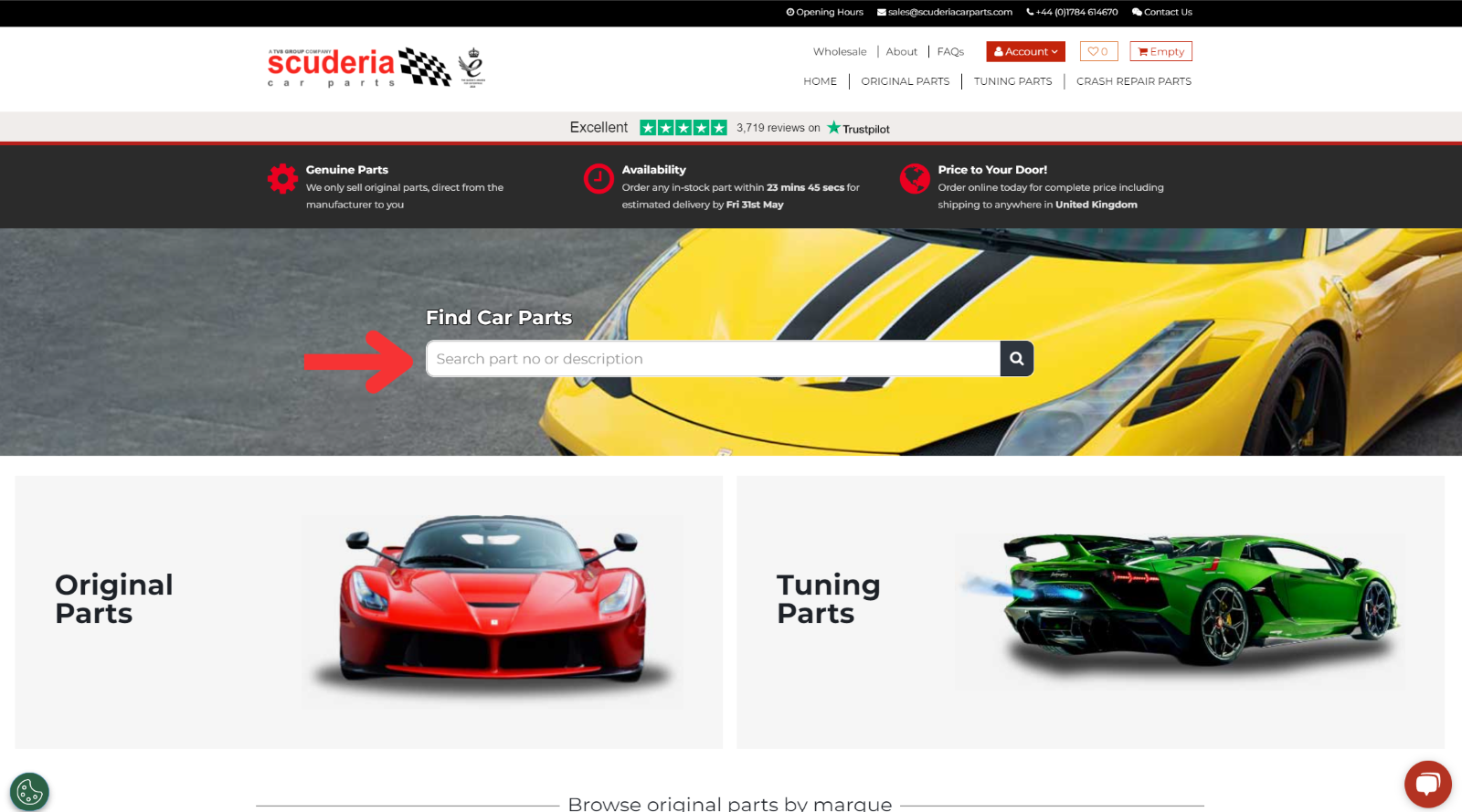
B) Navigate via marque > model > category > (diagram) > product detail page (PDP).
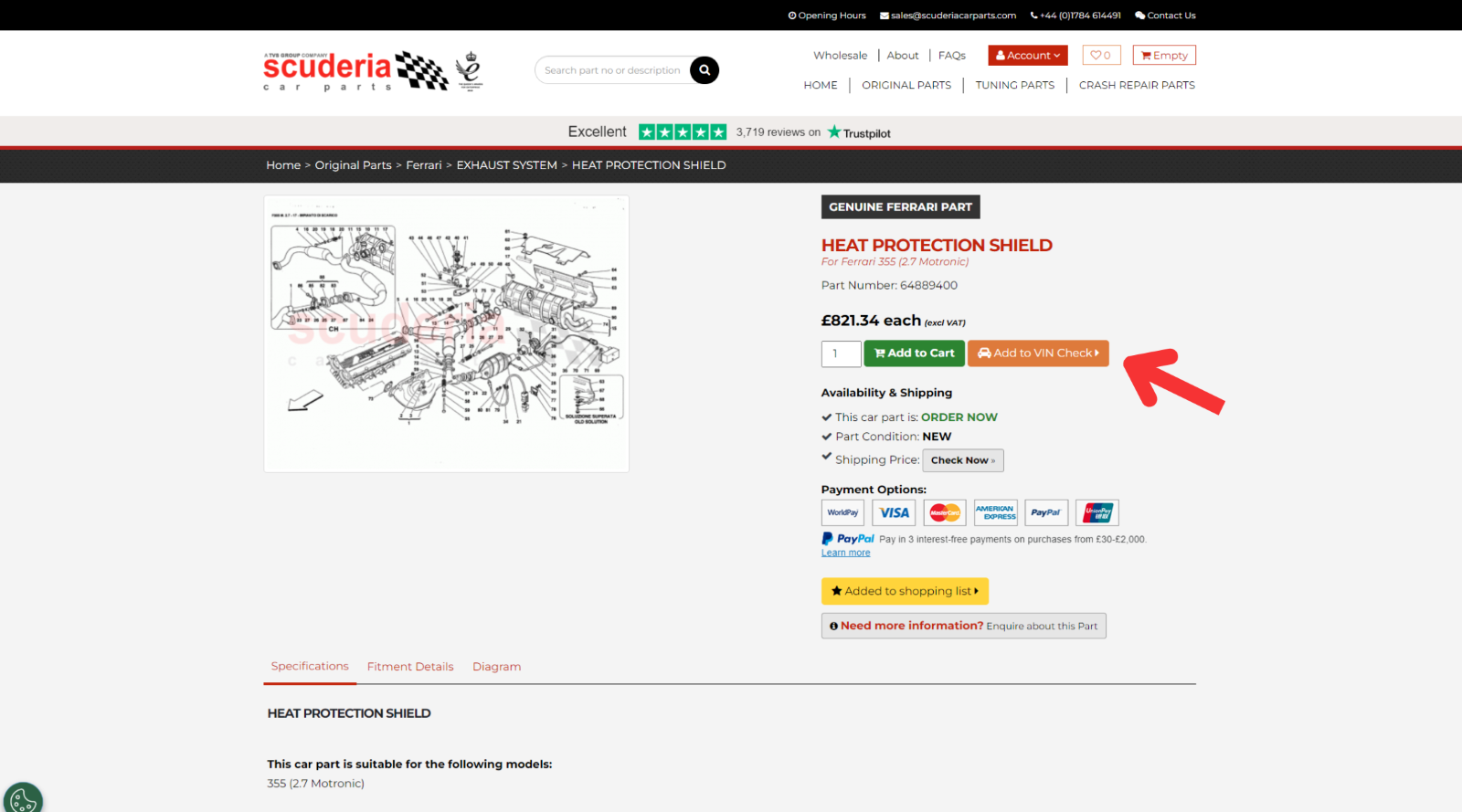
- Reach the correct product detail page
- Click on the VIN-Check button & populate the form
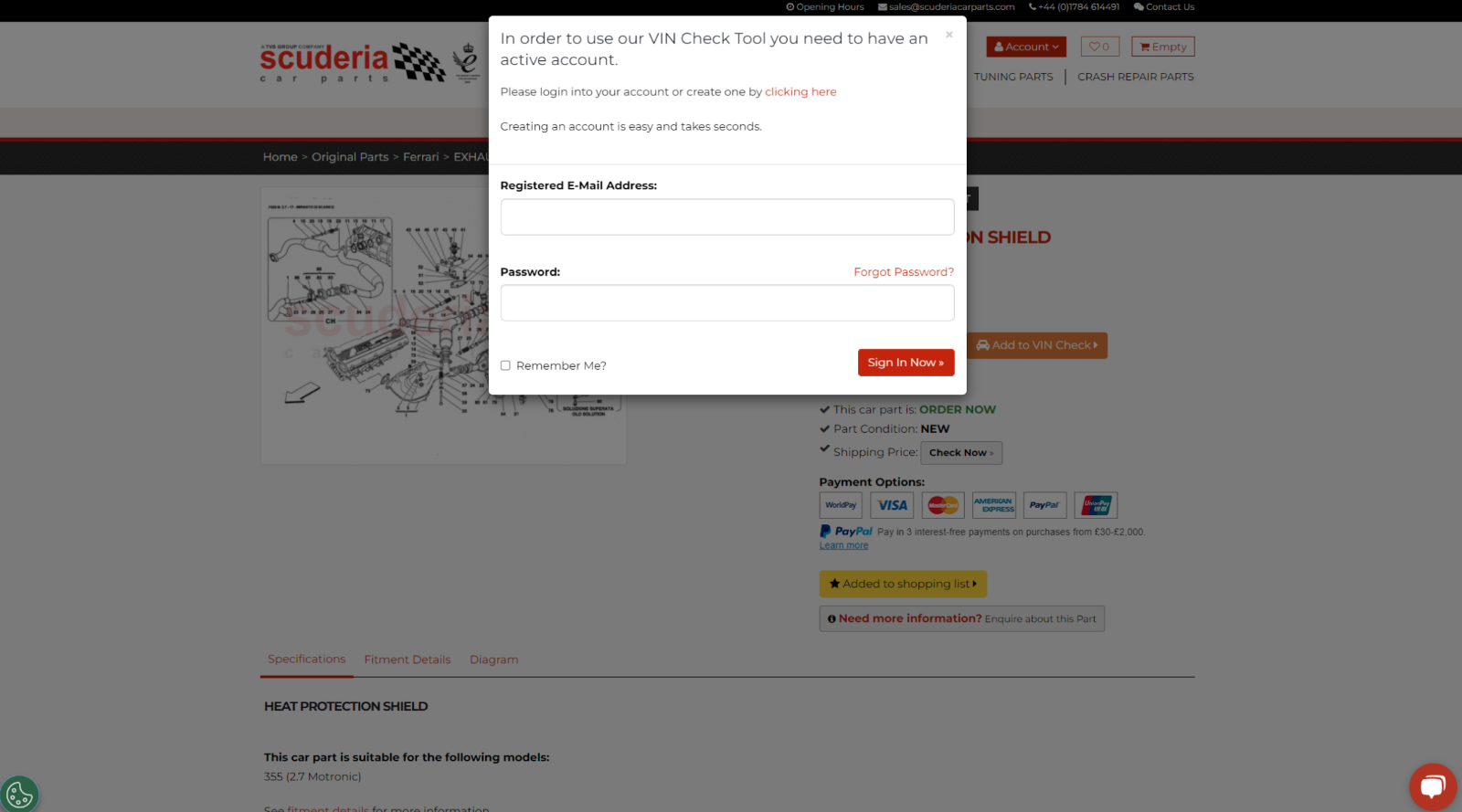
- Submit VIN number/Reg number.
Part number & marque will be automatically taken from the existing page.
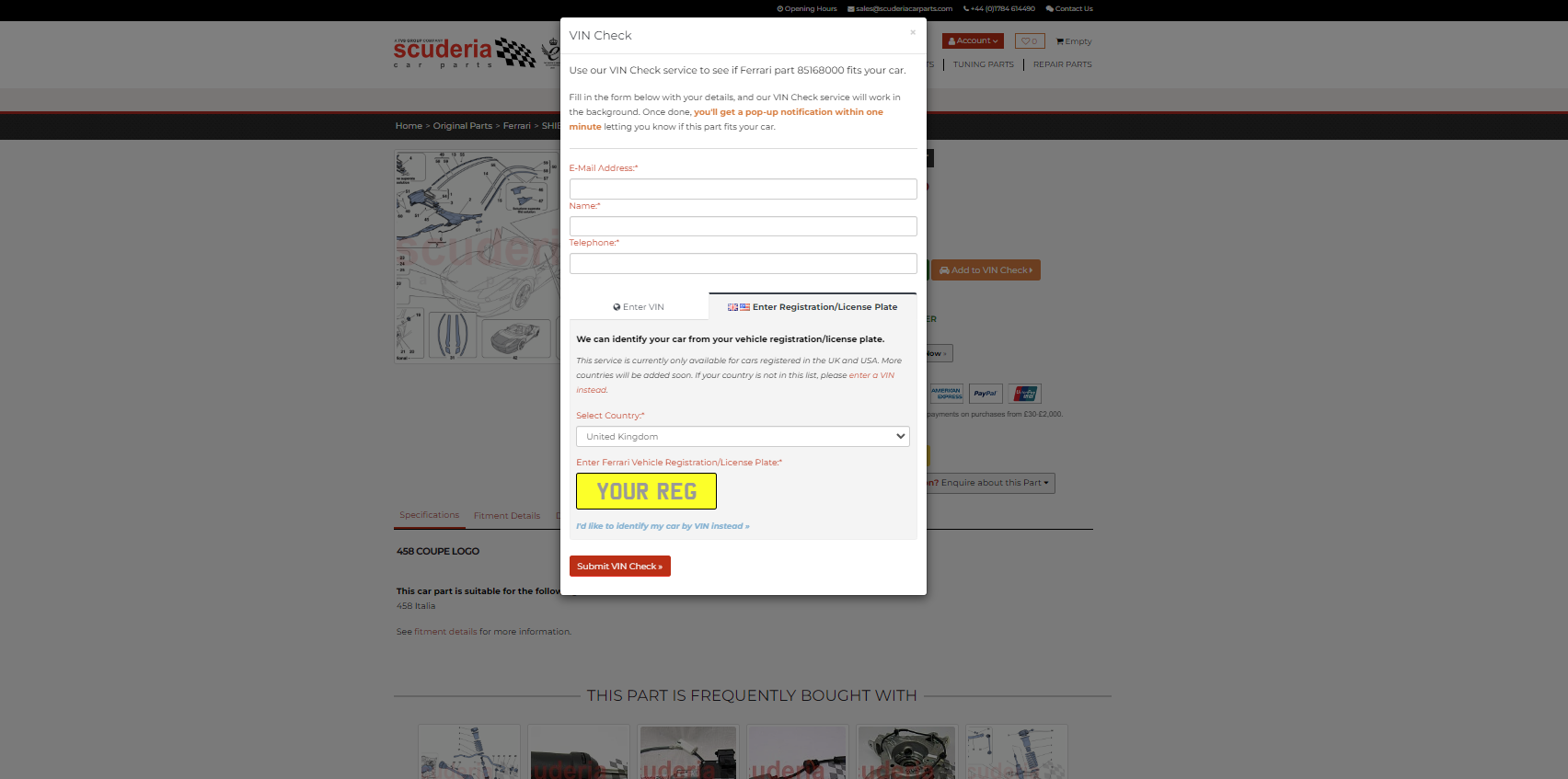
- Click ‘submit’ for ‘VIN-Check’.
- Wait for the response.
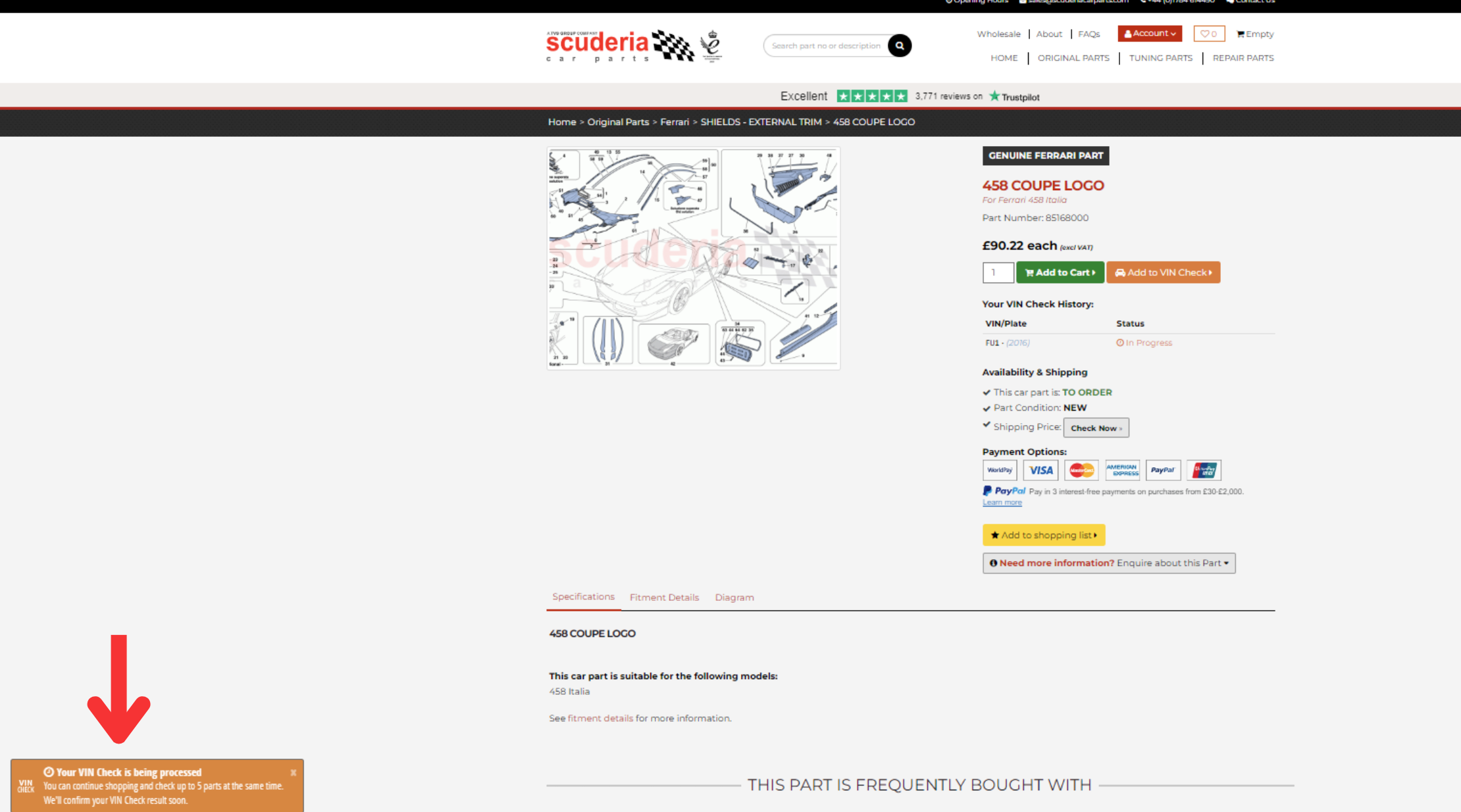
- Receive a response from VIN-Check.
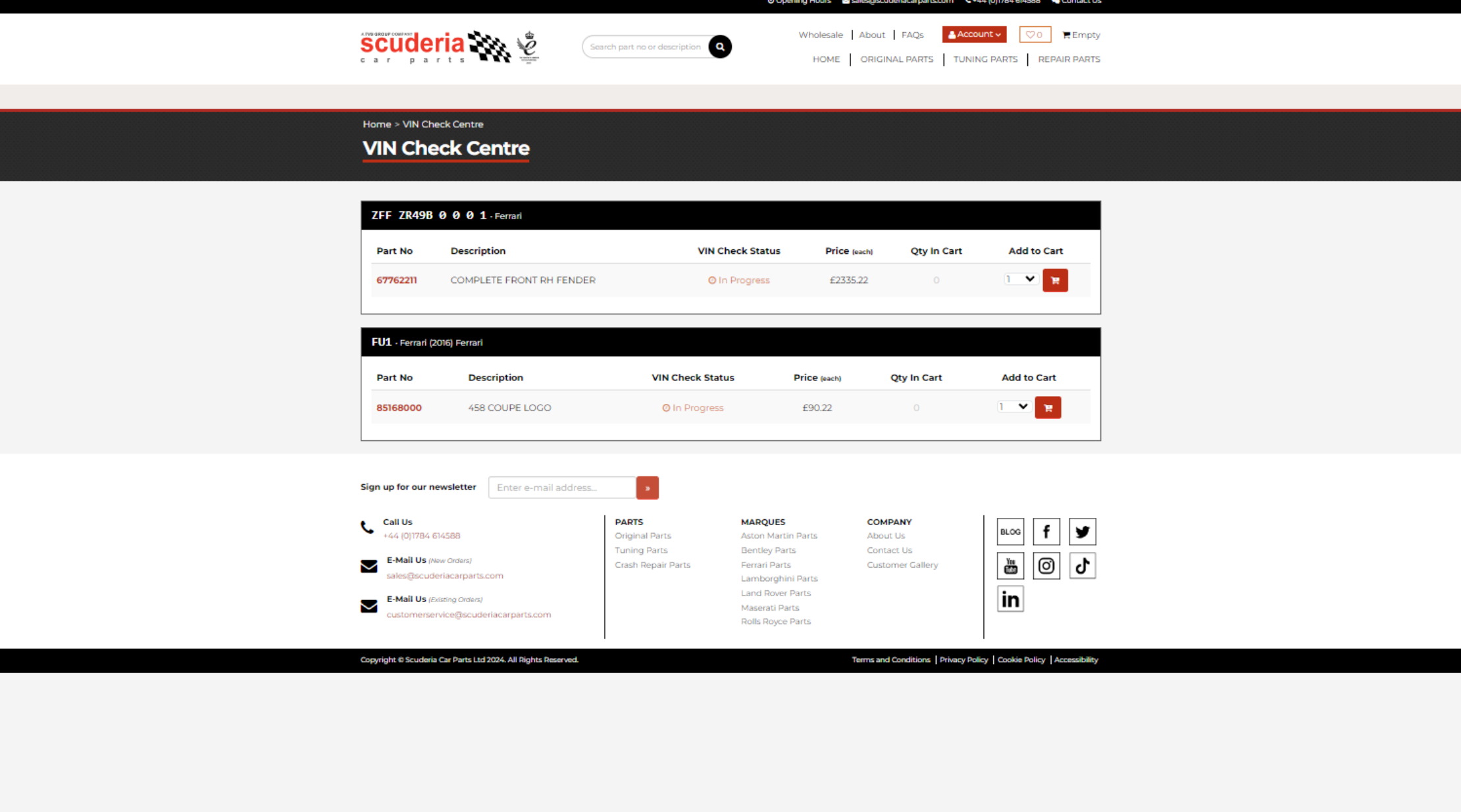
- The response will be one of the below:
- Fit – The part is compatible with your car.
- Alternative part suggested – The part entered is not a fit for your car, however you now have the suggested part number you require.
- Not a fit – The part is not a fit.
- Inconclusive – If inconclusive, our part advisors will be in touch as soon as possible.
Start VIN checking parts for your car today – scuderiacarparts.com
Frequently Asked Questions
1. Why check the VIN before buying a spare part?
The VIN decodes your car’s exact build spec — engine, gearbox, market, options, and production date. Even identical-looking parts can differ between trims or facelift years, and a VIN check eliminates costly mismatches.
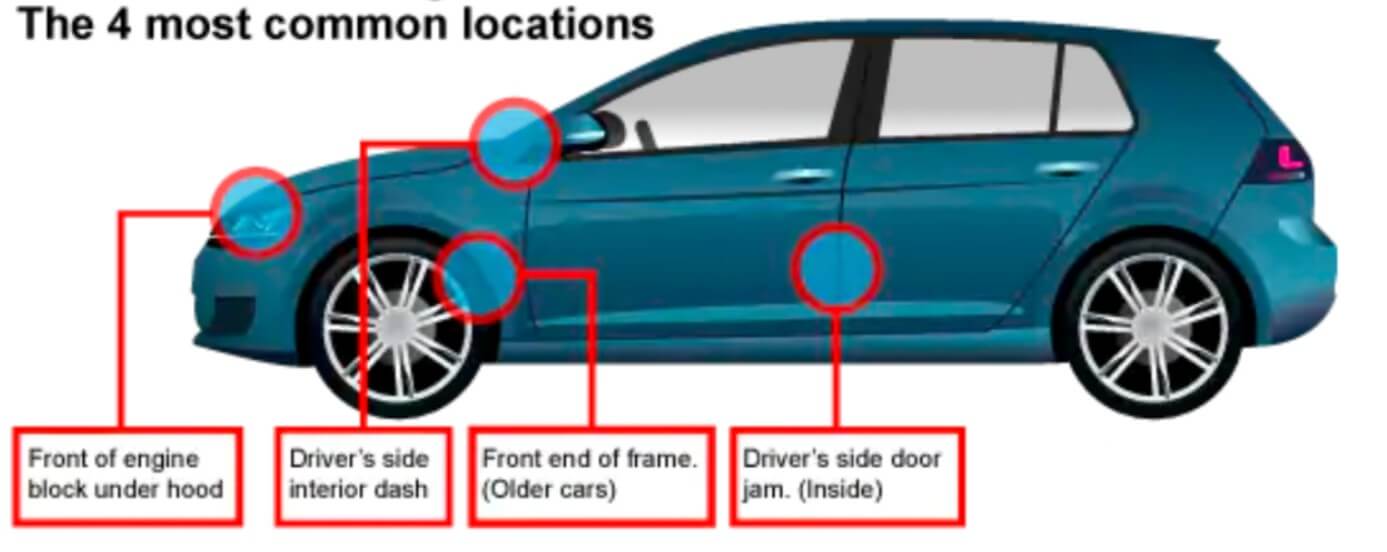
2. Where can I usually find my car’s VIN?
Most commonly on the lower corner of the windscreen (driver’s side), inside the driver’s door jamb, and on the V5C/registration document. On many European cars, it’s also stamped into the chassis under the bonnet or passenger floor mat.
3. What if I don’t have access to the VIN?
You can use the registration/number plate on most online catalogues which cross-reference DVLA data to the VIN. As a fallback, the engine code on the cam cover or block is often enough for service items. Without the VIN you may find your part by car model, edition and year but it won’t 100% guarantee that parts are genuinely compatible. OEM catalogues (Bentley’s own ESP) map every part number directly to the VIN. If a seller can’t confirm fitment by VIN, treat the listing as a guess, not a guarantee.
4. What’s the most common mistake people make when ordering by VIN?
Assuming pre- and post-facelift parts interchange. A 2017 and 2018 model can share a VIN prefix but use entirely different sensors, looms, or brackets. Always confirm the production date, not just the model year.
Practical VIN Decoder Cheat Sheet
A VIN is always 17 characters (since 1981). It never contains the letters I, O, or Q to avoid confusion with 1 and 0. It splits into three blocks: WMI (1–3), VDS (4–9), and VIS (10–17).
VIN Structure At A Glance
Positions 1–3 — World Manufacturer Identifier (WMI)
Identifies the country, region, and manufacturer.
– Position 1: Country/region of origin (e.g. S = UK, W = Germany, 1/4/5 = USA, J = Japan).
– Position 2: Manufacturer (e.g. C under S = Bentley; A under W = Audi).
– Position 3: Vehicle type or manufacturing division.
Positions 10–17 — Vehicle Identifier Section (VIS)
The car’s unique fingerprint.
– Position 10: Model year. Uses a letter/number cycle — e.g. M = 2021, N = 2022, P = 2023, R = 2024, S = 2025, T = 2026.
– Position 11: Assembly plant (e.g. Crewe for Bentley, Bratislava for Bentayga bodies-in-white).
– Positions 12–17: Production serial number — the unique sequential build number of that specific car.
A Quick Worked Example
example: SCBCR63W5DC078412
SCB → Bentley, UK
CR63W → Continental GT, W12 6.0
5 → check digit
D → 2013 model year
C → Crewe assembly
078412 → 78,412th car off that line
 Please wait...