
It feels like AI is slowly taking over the world. LLMs ( Large Language Models) have had a demonstrable impact on almost every sector and it’s fair to say machine learning has dominated technological discourse for the past few years. Its capability to process data, recognise patterns, and make data-driven decisions simplifies, previously labour-intensive human work.
The luxury car industry is no outsider to this phenomenon and we’re going to explain exactly how machine learning is augmenting everything.
AI’s Role in Supercars’ Development
Design and Engineering
Developing supercars can be a lengthy process. Although AI can’t fully replace human creativity, it can enhance the design process behind supercars.
One of the brands that has utilised AI for its design is McLaren. They’ve used machine learning algorithms to analyse thousands of designs simultaneously. It’s time-consuming when done manually, considering the amount of data available.
AI systems can quickly identify potential aerodynamic improvements by processing data from wind tunnel tests and computational fluid dynamics simulations. This technology alone has allowed McLaren to reduce its design iteration time by around 45%. Thus, McLaren can bring innovations to the market much faster than before.
McLaren isn’t the only one using AI during development. Ferrari, renowned for its beautiful craftsmanship, implemented AI during its manufacturing stage. The technology detects microscopic flaws in carbon fibre components that are invisible to the human eye.
Thus, Ferrari can increase the effectiveness of its quality control system. At the same time, it ensures that every vehicle it produces leaves the factory only after meeting its exact standards.
Personalised Customer Experience
We’ve seen supercar manufacturers providing customisation options traditionally before the age of machine learning. However, ever since AI became more significant, manufacturers started utilising it to take personalisation to the next level.
One of the more well-known AI-based personalisation programs among supercar brands is Lamborghini’s Ad Personam program. This innovation allows you to visualise potential customisation in real life.
It’s a system that can generate photorealistic renderings of the cars with different options. Thus, you’ll get to mix and match your preferred colour combinations, features, and interior materials to see how your supercar looks before purchasing it.
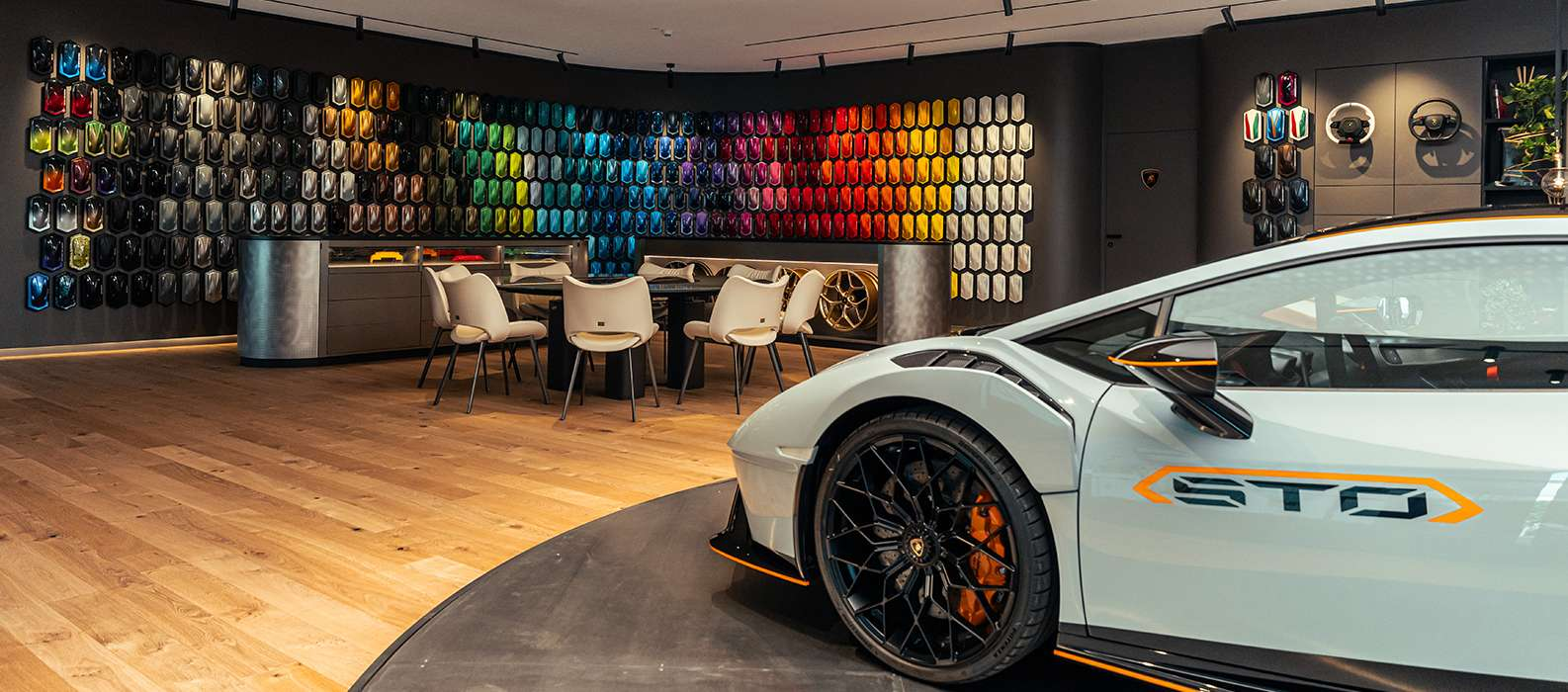
Lamborghini updates its Studio Ad Personam – Photo by Lamborghini.com
Ferrari’s AI Utilisation for F1
Ferrari hired Marco Adurno from Red Bull in 2020 to work on its AI implementation. Four people worked with him to create an artificial intelligence system applicable to F1, which then spread to a team of Ferrari engineers.
It finally reached the public eye during 2024’s SF-24 performance in F1. The supercar became the first competitive Ferrari with AI supporting its performance.
Ferrari implements AI to eliminate discrepancies between track performance and wind tunnel data. The correlation is hard to achieve, but AI’s meticulous data analytics can simultaneously process the track and all simulations. The AI then identifies deviations and suggests corrective actions.
The technicians will then adjust the AI’s values to improve the simulations further. This ensures the Scuderia performs immediately once on track, even if they haven’t been physically tested.
Charles Leclerc demonstrated the AI’s capability, going against Max Verstappen and Red Bull. The AI helped make the demonstration run well despite Leclerc missing the free practice sessions.
Aston Martin and Formula 1
Ferrari wasn’t the only one to showcase its AI implementation during F1. Aston Martin has a partnership with Red Bull Racing, which allowed the transfer of Formula 1’s AI technology to road cars.
The Valkyrie hypercar has an AI system aimed at F1 that optimises aerodynamics in real time. It adjusts multiple elements of the car’s body to minimise drag or optimise downforce based on conditions.
During development, the AI also provides simulation tools for Aston Martin to test prototypes virtually in thousands of scenarios before they go into the building stage. This step significantly reduces costs without sacrificing quality and performance, which is impossible to achieve when done traditionally.

McLaren and Dell Technologies
McLaren partners with Dell Technologies to develop and implement AI in its cars. They mainly focus on digesting a large amount of data using AI, especially for its F1 application.
Alain Prost and Ayrton Senna were known as prominent data collectors. They aimed to see the results translate on track, but everything was done manually using a pen, a stopwatch, and paper. Thus, they could only record a car’s speed through each circuit section.
This data gathering aims to explore quicker cars, use the data to improve braking and acceleration, study the racing lines, and understand how the vehicles perform when approaching corners.
The way people collect data has evolved, even before the AI era. The one significant change was wireless transmission, which automatically allows sensors to transfer data from the car to Dell Technologies’ data centre. Then, car sensors became lighter and had less impact on the speed.
Cars are now equipped with 300 to 600 sensors per session, which the Dell Technologies AI Factory collects. They measure tyre temperatures, air intake, engine condition, gear ratios, and the airflow of the cars. However, the most significant data is aerodynamic.
After collecting the data, McLaren uses it during sessions to make better-informed decisions or for operational reasons. Some became feedback for the factory team, which is working on upgrades and upcoming races to improve car designs and enhance their speed.
The data can tell the team about each car’s weaknesses and strengths, which are highly useful in eliminating shortcomings in the long term and enhancing the already present strengths.

Lamborghini’s Telemetry X
Lamborghini introduced its AI-based innovation, Telemetry X, at the Las Vegas Consumer Electronics Show (CES). It’s an innovative track connectivity concept that has the potential to be implemented in various ranges of future super sports cars. This concept aims to use AI to guide you on the track.
Stephan Winkelmann, the Chairman and CEO of Automobili Lamborghini, stated that they focus on innovation. After creating the Revuelto, followed by the Lanzador, which introduced a fully electric concept car, they aim to provide immersive driving experiences, which they plan to achieve through Telemetry X.
Lamborghini has teamed up with Accenture to showcase a prototype system that integrates three cutting-edge technologies, all operating at 5G speeds. The first innovation, called the Remote Garage, leverages the vehicle’s 5G connectivity to stream high-res video and detailed telemetry data to a driver coach remotely.
In short, it’s a web application that can run due to 5G technology. This enables drivers to access live video feeds alongside their telemetry and track data. Thus, the technology can always be virtually present and coach the driver regardless of the track location.
The second technology in the trio is the Biometric Data System. It details the driver’s body condition, such as heart rate and stress level, which can contribute to the potential training feedback.
The last technology is the Digital Co-Pilot. Drivers will get an AI voice assistant to guide them while driving and enhance their on-track performance. It can, for example, analyse lap times and provide pointers to improve braking points and racing lines. It also delivers insights into the car’s real-time track performance.
The Importance of Genuine Parts for AI-Powered Systems
AI in the automotive industry is still in development. Few supercars use AI, which makes genuine parts more crucial than ever.
Enhancing Compatibility with Your Vehicle
When you choose genuine parts, you buy parts suitable for the vehicle’s specific model. On the contrary, generic parts are usually made to cater to various types of cars.
This is an essential point you shouldn’t overlook in AI-powered systems, as it can affect how the AI system functions. Generic parts might not be able to work as effectively or precisely as the genuine parts, which can lead to mechanical problems.
Improving Efficiency and Performance
Genuine parts provide higher accuracy and better strength due to their perfect suitability. This keeps your car performing effectively, as the parts were made to a top standard. Genuine parts can give you higher reliability while keeping your supercar at peak performance, especially during challenging circumstances.
Genuine parts won’t only take care of your car’s engine, but they also optimise fuel efficiency. Conversely, aftermarket or inferior parts can upset the system’s equilibrium. This can lead to increased fuel consumption. Over time, OEM parts may prove more economical compared to generic alternatives.
Prolonged Vehicle Lifespan
Generic parts are generally easier to break. However, genuine parts are made with high-quality design, withstand daily use, and offer higher durability. This affects the parts’ condition and helps maintain the overall condition of your car, as they minimise strain on the car’s system.
Ensuring Safety
Maintaining safety ranks among the top priorities in vehicle upkeep. Genuine parts or aftermarket upgrades will help you ensure everything works well, especially during emergencies. Safety systems like airbags, suspension elements, and brake pads are engineered to withstand extreme conditions. These parts are crucial in keeping you safe while driving and protecting you from a serious accident.
Authentic parts reach the market only after extensive testing and rigorous quality assurance. Supercar makers prioritise their components and strictly comply with safety regulations. This promises an extra layer of security for you as the driver and fulfils the expected performance from the car. Authentic parts not only enhance your vehicle’s capabilities but also represent a valuable safety investment.
 Please wait...